
La ERGE es una enfermedad causada por el flujo retrógrado del contenido gástrico a tráves de una unión gastroeso-fágica que puede estar incompetente.
La enfermedad presenta un amplio espectro de síntomas a nivel esofágico (considerados como típicos) y a nivel extraesofágico (atípicos) como son los síntomas laringofa-ríngeos y los procesos respiratorios crónicos. Es por ello que pacientes con manifestaciones extraesofágicas de ERGE son evaluados frecuentemente en la consulta otorrinolarin-gológica por síntomas a nivel de oídos, nariz y garganta sin que en la mayoría de casos se reporten síntomas típicos de reflujo como la pirosis (18). Incluso se ha llegado a pensar que son enfermedades diferentes y por lo tanto se deben denominar reflujo gastrolaríngeo.
Es común encontrar que estos pacientes con síntomas laríngeos presentan además otros factores irritantes implicados tales como el cigarrillo, el alcohol y el abuso de la voz, por lo cual debemos hacer un abordaje integral para su estudio y tratamiento.
La primera asociación importante entre síntomas laríngeos y reflujo gastroesofágico fue reportada por Cherry y Margulies en 1968, en 3 pacientes con úlceras de contacto en laringe y reflujo significativo en los estudios con bario (9). En 1980 aparecen los primeros reportes con síntomas laríngeos y monitoría de pH de 24 horas y en 1987 Weiner y cols., reportan el uso de monitoría de pH con doble sensor (29).
En este informe se presenta la evaluación de 40 pacientes que consultaron por diferentes síntomas laringofaríngeos como disfonía, aclaramiento de la voz, sensación de cuerpo extraño, tos, pirosis, regurgitación, eructos, halitosis y disfagia y a los cuales se les realizó videoestroboscopia laríngea, endoscopia digestiva superior y monitoría de pH esofágico con doble sensor durante 24 horas. Se implementaron estos tres estudios tratando de realizar una aproximación diagnóstica más certera.
Se encontró una proporción mayor de mujeres afectadas por la enfermedad no siendo este hallazgo estadísticamente significativo en nuestro estudio (p>0,05). No encontramos literatura acerca de la contribución de las variantes sexo y edad en dicha patología, pero si se describe una relación mayor hombre a mujer (2-3/1) en reflujo gastroesofágico patológico (30).
Al revisar los síntomas laringofaríngeos la disfonía se presenta en el 75% (n=30) similar a las grandes series de pacientes de ORL en los cuales la disfonía es el síntoma más frecuente entre 88%-92% (4, 18). Este patrón de disfonía puede ser crónico, continuo e intermitente. Los otros síntomas estudiados se presentan con una frecuencia similar a este informe: aclaramiento de la voz 50%; tos crónica 44%; sensación de cuerpo extraño 33%; disfagia 27% (4).
La presentación con síntomas esofágicos típicos va desde 25% a 50% según Koufman; en este estudio se hallaron desde 15% a 50%.
La diferencia en la presentación clínica, la falta de hallazgos endoscópicos macroscópicos, la presencia de un E.E.I. normal y un mayor número de exposición al ácido de pie que en supino, han llevado a los autores a considerar que se trate de dos patologías diferentes (4).
Los hallazgos descritos en la videoestroboscopia de los 9 pacientes con reflujo proximal documentado, muestran la congestión interaritenoidea (77,8%) y la irritación de cuerdas vocales (55,6%) como los hallazgos más frecuentes. Coincide esto con los hallazgos descritos por Koufman (4), entre los que se encuentran el edema laríngeo como el hallazgo más común.
Los hallazgos endoscópicos en este informe mostraron que el 35% (14/40) de los pacientes tenían una endoscopia normal. Cuando se analizaron los 9 pacientes con diagnóstico de reflujo gastrolaríngeo, los hallazgos endoscópicos mostraron normalidad en 44,4% y esofagitis grado I en 44%, similar a lo reportado por Koufman en uno de sus estudios (18).
Sin embargo, algunos autores han considerado de importancia el estudio histológico del esófago en estos pacientes sin hallazgos macroscópicos de esofagitis. Se busca como cuadro histológico un engrosamiento de papilas esofágicas y una hiperplasia de células basales; estos hallazgos carecen de especificidad porque se pueden encontrar en el 20% de pacientes normales; también la identificación de neutrófilos y eosinófilos como indicadores de inflamación aguda han sido encontrados en especímenes de biopsia de esófago (19 a 60), pero su hallazgo es poco específico ya que se muestran eosinófilos en 10% a 30% de los pacientes sanos (15, 16). Por estas razones nuestro grupo no recomienda el estudio histológico como método diagnóstico para la enfermedad laringofaríngea.
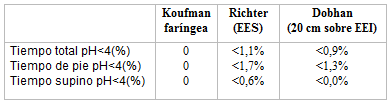
Revisando la literatura se encuentra que no hay consenso en la colocación de la sonda proximal (20 cm por encima de EEI; justo debajo del EES o hipofaringe). Aunque colocar la sonda proximal en la faringe permitiría mejor discriminación entre pacientes sanos y pacientes con reflujo, pueden resultar artefactos debido a que se puede secar o humedecer alterando la impedancia del circuito, variando también el valor del pH y reportando fenómenos de “seudo-reflujo” (8); igualmente el moco de la vía aérea superior puede impedir que se registren episodios de reflujo ácido. Tampoco hay consenso en la sensibilidad de la prueba, ni en el valor de corte para la sonda proximal; por ejemplo, Koufman colocando la sonda proximal a nivel faríngeo asume el valor de corte como 0; para Richter colocando la sonda proximal en el EES, el valor de corte es 1% y para Dobnan, colocando la sonda proximal 20 cm encima del EEI el valor es 0,9% (23) (Tabla 2).
En este estudio se utilizó la sonda proximal a nivel del EES como lo reporta Richter, por lo cual utilizamos su valor (<1%) para definir con certeza el diagnóstico de reflujo gastrolaríngeo. De esta forma fueron 9 pacientes (22,5%) los que cumplieron con este criterio, siendo probable que muchos de los pacientes restantes hayan sido diagnosticados falsos negativos.
Al respecto Koufman propone que si un paciente tiene pH-metría esofágica distal anormal o hallazgos macroscópicos de ERGE, y síntomas y signos laríngeos compatibles con el diagnóstico, se puede diagnosticar enfermedad laringofaríngea por reflujo (4, 7).
En este estudio, de los 31 pacientes supuestamente sin enfermedad (o no diagnosticados por pH-metría proximal), 11 (35,5%) presentaron síntomas y signos laríngeos con un De Meester mayor de 14,7 y esofagitis, los cuales podrían corresponder a falsos negativos, lo que apoya lo reportado en la literatura: cuando se utiliza pH-metría con doble sensor más de 20% de los pacientes con reflujo gastrolaríngeo pueden tener resultados falsos negativos a causa de la naturaleza intermitente de la enfermedad.
Conclusiones
1. No se halló la alta prevalencia de la enfermedad laringofaríngea por ERGE (40%-80%), y por el contrario se encontró una cifra relativamente baja (22,5%) debido tal vez al uso de un criterio pH-métrico proximal con un valor de corte de 1,1% del porcentaje del tiempo total con pH menor de 4 en sonda proximal; además la naturaleza intermitente de la enfermedad hace que un solo monitoreo de pH de 24 horas no registre episodios de acidez proximal; enotras palabras, la sensibilidad puede ser baja y el número de pacientes con reflujo gastrolaríngeo puede ser más alto que el hallado.
2. Se confirmó la presencia de un grupo de pacientes con enfermedad laringofaríngea por reflujo que no tenían esofagitis, lo que coincide con lo descrito en la literatura.
Tabla 2 Valores normales para la sonda proximal
3. Se encontró un caso de ectopia gástrica como diagnóstico diferencial de reflujo gastrolaríngeo.
4. Se encontró una distribución por frecuencia de síntomas y signos similar a la referida en la literatura mundial, y una mayor prevalencia de la enfermedad en el sexo femenino; estos hallazgos no tuvieron significancia estadística.
5. El hallazgo de un paciente con ca laríngeo apoya lo descrito en la literatura por cuanto el reflujo gastrolaríngeo puede ser un cofactor etiológico primario de esta patología (10 – 12).
6. Este Trabajo resalta la importancia del estudio de estos pacientes con videolaringoestroboscopia y endoscopia digestiva; la pH-metría esofágica con doble sensor (proximal y distal) consideramos, se debe reservar para situaciones especiales, dada la alta prevalencia de la enfermedad.
7. Es importante adelantar un estudio en nuestro medio, de los valores pH-métricos proximales en personas sanas y así definir el punto de corte diagnóstico de enfermedad laringofaríngea por ERGE.
Abstract
Purpose
To determine the proportion of patients with chronic laryngopharyngeal disease caused by gastroesophageal reflux and to describe the spectrum of laryngopharyngeal alterations resulting from this pathology.
Desing
A descriptive, prospective study of 40 adult patients with chronic laryngopharyngeal symptoms, who underwent a paraclinical study consisting of double sensor pH metering, videolaryngostroboscopy and digestive videoendoscopy.
Results
The esophageal pH-metering used showed 22.5% of the patients with chronic laryngopharyngeal disease attributable to gastroesophageal reflux, greater prevalence was found in women; no statistical significance was found in any of the signs and symptoms studied in these patients. A case of gastric ectopia was found as a possible diagnostic differential and one patient was found to have laryngeal cancer.
Conclusion
No high prevalence of the disease was found in the sample patients studied. However, it is possible that it was not detected in some of the patients owing to the pH-metering criterion used and the intermittent nature of the disease.
Key words: Gastroesophageal Reflux Disease. Gastrolaryngeal Reflux. Inferior Esophageal Sphincter. Superior Esophageal Sphincter. pH metering.
Correspondencia: Dr. Johnny Jiménez, Servicio de Otorrinolaringología. Hospital San Vicente de Paul. Medellín, Colombia.
Bibliografía
1. Casabuenas P, Camacho DF. La Esofagitis Péptica por Reflujo Gastroesofágico y Endoscopia Digestiva. Revista Colombiana de Gastroenterología. 1990; 4: 227-231.
2. Tanouye E. Battle Brews in the heartburn business as two old drugs go over the counter. Wall street Journal 1995.
3. Kambic V. Radsel Z. Acid posterior laringitis, aetiology, histology, diagnosis and treatment. J Laryngol Otol 1984; 98: 1237-12240.
4. Koufman JA, et al. The prevalence and spectrum of reflux in laringology: a prospective study of 132 patients. Documento de Internet.
5. Wiener GJ, Koufman JA, Wu WC, Cooper JB, Richter JE, Castell DO. Chronic hoarseness secondary to gastrophageal reflux disease: documentation with 24-H ambulatory pH motoring. Am J Gastroenterol 1989; 84: 150-1508.
6. Katz PO. Ambulatory esophageal and hypofaryngeal pH monitoring in patients with hoarseness. Am J Gastroenterol 1990; 85: 38-40.
7. Koufman JA: Obice Disorders. Visible obice apri 1992; 1: 2-3.
8. Richter JE. Typical and atypical presentation of gastroesophageal reflux desease. GI Cli North America. 1996; 25: 75-102.
9. Cherry J, Margulis SI. Contact ulcer of the Larynx. Laryngoscope 1968; 78: 1937-40.
10. Steigman GV, Pearlman NW, Teter A. Upper aerodigestive manifestation of Gastrophageal Reflux. Abstract Gastroenterology. 1987; 92: 165-4.
11. Morrison MD. Is chronic gastroesophageal reflux a causative factor in glottic carcinoma? Otolaringol Head and Neck Surg 1998; 99: 370-73.
12. Ward PH, Hanson DG. Reflux as an aetiologic factor of carcinoma of the laryngopharynx. Laringoscope 1998; 98:1195-99.
13. H, Hanson DG. Reflux as an aetiologic factor of carcinoma of the laryngopharynx. Laryngoscope 1998; 98: 1195-99.
14. Champion GL, Richter JE. Atypical presentation of gastroesophageal reflux disease: Chest paint pulmonary, and ear, nose, troat manifestations. Gastroenterology 1993; 1: 18.
15. Jacob P, Kahrilas PJ, Herxon G, Proximal esophageal pH-metry in patients reflux laringitis. Gastroenterology 1991; 100: 305-10.
16. Ohman I, Olofsson J, Tibbling, et al. Esophageal dysfunction in patients whit contact ulcer of the larynx. Ann Otol Rhinol Laryngol 1983; 92: 228-30.
17. Ossakow SJ, Elta G, Colturi T, et al. Esophageal reflux and dismolity as the bass for persistent cervical symptoms. Ann Otol Rhinol Laryngol 1984; 93: 430-7.
18. Shaker R, Milbrand M, Ren J, Toohill R. Esophagopharyngeal distribution of refluxed gastric acid in patients with reflux laringitis. Gastroenterology 1995; 109: 1575-85.
19. Koufman JA. the Otolaryngologic manifestations or gastroesophageal reflux disease. Laringoscope 1991; 101: (supl 53) 1-78.
20. Ossakow SJ, Elta G, Colturi T, et al. Esophageal reflux and dimotility as the basis for persistent cervical symptoms. Ann Otol Rhinol Laryngol 1997; 96: 387-92.
21. Koufman JA: pH monitoring in otolaryngology patients with gastroesophageal reflux disease: Why the pharyngeal probe is esential? (unpublished data), 1993. (Referido en Koufman JA: reflux and obice disorders).
22. Wolfe MM, Soll AH. The phisiology of gastric secretion. NEJM 1998; 319: 1707-15.
23. Wiener GJ, Cooper JB, Wu WC, et al: Is haornseness an atypical manifestation of gastroesophageal reflux (GER)? An ambulatory 24 pH study. Gastroenterology 1986; 90 A; 1691 (Abstract).
24. Richter JE, Ambulatory esophageal pH monitoring. American Journal of Medicine Nov 1997; 103: 130.
25. Toohill RJ, Mustang E, Grossman TW, et al: Pharyngeal, laryngeal and tracheobronchial manifestation of gastroesophageal reflux. Procedings of the XXIV World Congress of Otolaryngology – Head and Neck Surgery. Berkeley California: Kugler and Ghendini Publishing.
26. De Mester TR, Wang CI, Wernly JA, et al. Technique, indications and clinical use of hours esophageal pH monitoring. J Torca Cardiovasc Surg 1980; 79: 656-70.
27. Johnson LF, De Mester TR. Development of the 24 hours intraesophageal pH monitoring composite scoring system. J Clin Gastroenterol 1986; 9: 52-58.
28. Richter JE, De Meester. Ambulatory Esophageal pH monitoring: Practical Approach and clinical applications. Tokio: Igaku-Shoin, 1991.
29. Monnier P, Ollyo JP, Fontolliet CH and Savary M.: Epidemiology and natural history of reflux exophagitis. Semin Laap Surg 1995; 2: 2-9.
30. Wiener GJ. Koufman JA. The pharingoesophageal dual ambulatory pH probe for evaluation of reflux. Gastroenterology 1987; 92: 1694.
31. Weinstein WM, Goboch ER, Bowes KL. The normal human esophageal mucosa histologic readparasal. Gastroenterology 1995; 68: 40.